Contact us

How to Lift Shipping Containers Indoors

Gantry cranes and reach stackers are common solutions for handling containers indoors, but they can limit access and flexibility. This guide explores how portable container lifts work and how they can be used to lift, position, and move containers within a facility.

Bison Marketing

3 Jun 5 Minutes

Lifting

Handling ISO containers outdoors is relatively straightforward when there is space for equipment such as cranes, reach stackers, and side loaders. Move the same operation inside a warehouse, factory, or maintenance facility, however, and the available options become much more limited.

Large mobile equipment may not fit through building doors or have enough room to maneuver safely. Diesel-powered equipment can also introduce hazardous fumes into enclosed environments. Overhead gantry cranes solve many of these problems, but require permanent infrastructure and restrict container handling to the area the crane can reach.

For facilities that need greater flexibility, portable container lifts provide another way to lift, unload, position, and move ISO containers indoors.
How Are Shipping Containers Traditionally Lifted Indoors?

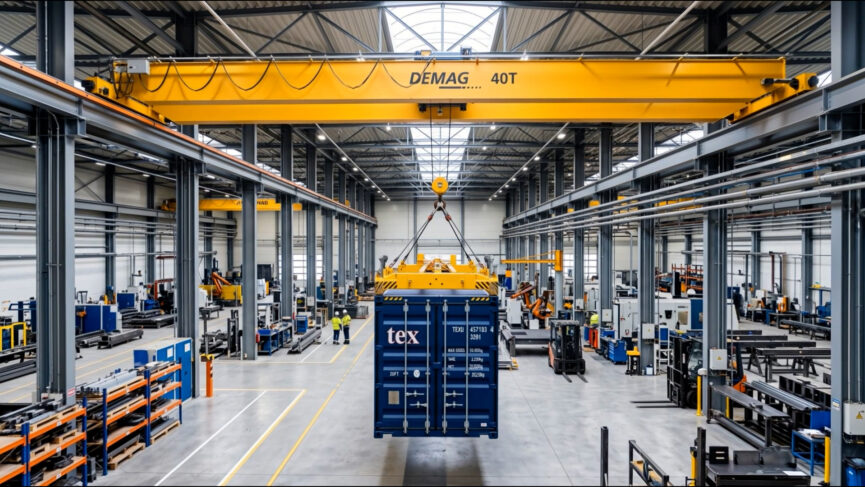
Overhead gantry cranes are one of the most established methods for handling heavy containers and equipment inside industrial facilities.

For operations with a consistent workflow, they make sense. A gantry crane can lift a container from a truck, move it within its operating area, and lower it into position without requiring large mobile lifting equipment inside the building.

In facilities where containers always arrive, move, and leave from the same location, this can provide an effective long-term solution.

The challenge comes when the operation needs to work outside that fixed lifting area or when operators want to futureproof their facilities.

Lift containers indoors 00 00 16 14 Still001

The Challenges of Indoor Container Handling

Indoor container handling generally creates two challenges: access and flexibility.

Equipment commonly used outdoors, such as reach stackers and mobile cranes, is large and requires significant operating space. It may not fit through standard building entrances, while restricted ceiling heights and tight indoor spaces can make maneuvering difficult.

Diesel-powered equipment can also create health and safety concerns when operating in enclosed spaces because of exhaust fumes.

Overhead gantry cranes avoid many of these access issues, but introduce a different limitation: they are fixed infrastructure.

A gantry crane can only operate within its installed lifting area. If containers need to be handled elsewhere in the building, the workflow changes, or the facility expands, the crane cannot simply move with the operation.

Installing or extending a gantry system can also require significant changes to the building and additional capital investment.

For some facilities, this leaves a choice between bringing unsuitable mobile equipment indoors or designing container handling workflows around permanent infrastructure and being locked in for years to come.

Smart Harvest 5

What Are Portable Container Lifts and How Do They Work?

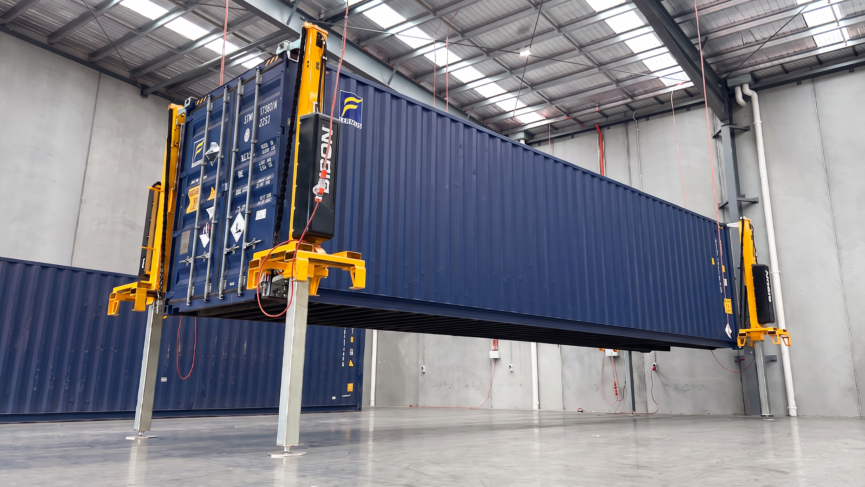
Portable container lifts are purpose-built systems that attach directly to an ISO container’s corner castings, allowing containers to be lifted without an overhead crane or large mobile handling equipment.

Because the lifting equipment is compact and portable, it can be moved to wherever containers need to be handled within a facility. This helps address both of the key challenges of indoor container handling: access and flexibility. The systems can operate in areas where larger equipment may struggle to access, without restricting container handling to a fixed lifting zone.

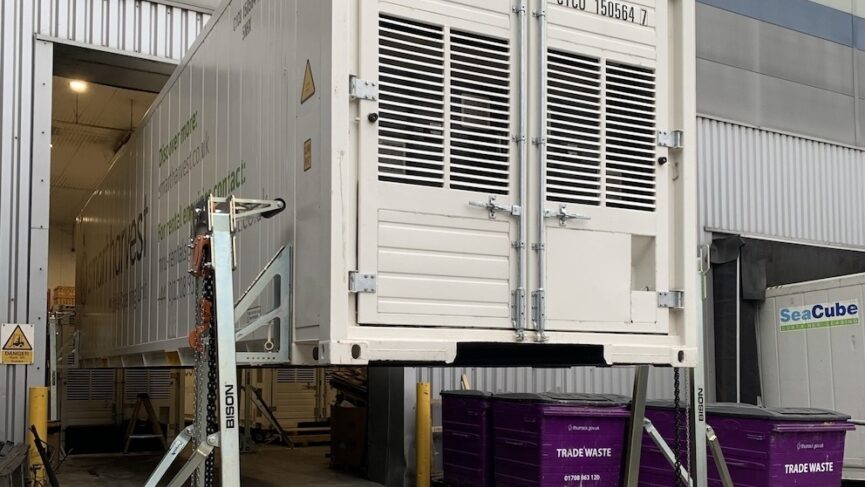
To lift a container, the lifting units are positioned at each corner and attached to the corner castings. Depending on the system, the container is then raised manually or automatically until there is sufficient clearance for the truck or trailer to drive out from underneath.

The container can then be lowered directly onto the floor, placed onto supports, or transferred onto container dollies for movement around the facility.

Portable container lifts are available for a wide range of container weights, with Bison systems capable of handling containers up to 45 tonnes (99,000 lb).

MGF Blue Container 1

How Can You Move a Shipping Container Around a Facility?

Lifting a container off a truck is only one part of indoor container handling.

Once the container is inside the building, it may need to be moved between loading areas, production lines, maintenance bays, storage areas, or other parts of the facility.

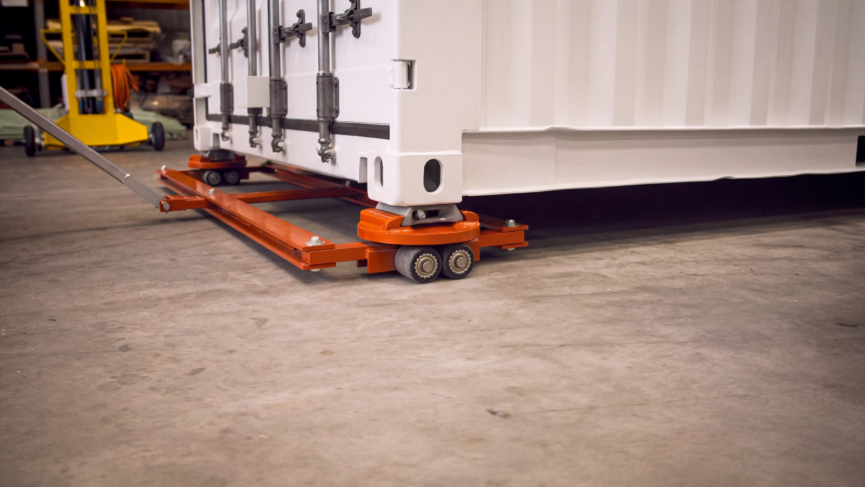
Portable container lifts can be used in combination with container dollies to make this possible.

After the container has been lifted clear of the truck, dollies are positioned underneath it and the container is lowered onto them. A forklift can then tow the container to another part of the facility.

When it reaches its destination, the portable container lifts can be used again to raise the container from the dollies before it is lowered onto the floor or supports.

The container can then be loaded, unloaded, serviced, modified, or stored in the most convenient location.

If access underneath the container is required, the lifting system can also elevate it to provide additional working clearance.

Make the container white and t Nano Banana 2 79164

Why Use Portable Container Lifts Indoors?

The main difference between portable container lifts and permanent lifting infrastructure is flexibility.

An overhead gantry crane is designed to perform lifting operations within a defined area. For facilities with predictable container movements, this can work well.

Portable container lifts allow the lifting equipment to move with the workflow instead.

The same system can unload a container from a truck in one part of the facility, transfer it onto dollies, and later be repositioned to lift another container elsewhere.

This can be particularly useful for facilities that are expanding, changing their layouts, handling different containerized equipment, or simply need the ability to work with containers in more than one location.

It also allows businesses to introduce or expand indoor container handling without necessarily investing in permanent overhead lifting infrastructure.

481038443 1084483263694391 7434649089283279868 n

Where Are Portable Container Lifts Used Indoors?

Portable container lifts can support indoor container handling anywhere ISO containers or containerized equipment need to be unloaded, positioned, moved, or worked on inside a facility.

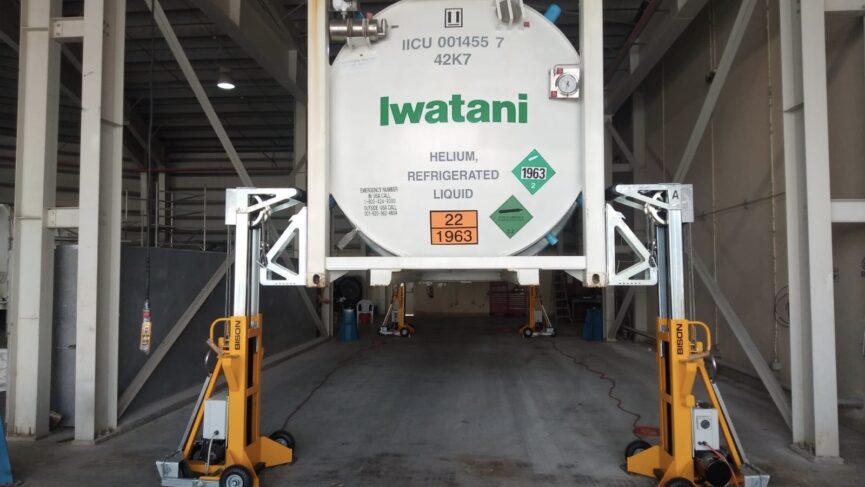
This can include warehouses, manufacturing facilities, maintenance and repair operations, logistics facilities, industrial gas facilities, and businesses manufacturing or modifying containerized systems.

The right lifting system depends on the weight of the container, available space, required lifting height, floor conditions, workflow, and how frequently containers need to be handled.

Buzwair16062021 3 1 4

Frequently Asked Questions

  • Can you lift a shipping container inside a warehouse?

    Yes. Depending on the facility and container weight, shipping containers can be handled indoors using equipment such as overhead gantry cranes or portable container lifts.

    Portable container lifts attach directly to the ISO container's corner castings, allowing the container to be raised vertically without requiring a crane to operate above it.

  • How do you unload a shipping container indoors without a crane?

    Portable container lifts make it possible to unload a shipping container indoors by creating clearance between the container and the truck or trailer, without relying on an overhead crane.

    The lifting units attach to the ISO container's corner castings and raise the container until the vehicle can drive out from underneath. From there, the container can be lowered directly onto the floor for loading or unloading, placed onto supports, or transferred onto container dollies and moved to another part of the facility.

    This allows containers to be unloaded wherever they're needed inside a warehouse or manufacturing facility, rather than being limited to a fixed crane bay.

  • How do you move a shipping container around a warehouse?

    Container dollies can be used to move ISO containers around suitable indoor facilities.

    The container is lifted and lowered onto the dollies before being towed using a forklift. At its destination, portable container lifts can transfer the container from the dollies back onto the floor or supports.

  • Can portable container lifts replace a gantry crane?

    Yes. For facilities where containers are always handled in one defined area, a gantry crane can provide an effective permanent solution.

    Portable container lifts may be more appropriate where containers need to be handled in multiple locations, workflows change regularly, or installing fixed lifting infrastructure is impractical.

  • What equipment is needed to lift shipping containers indoors?

    The right equipment depends on the container's weight and dimensions, the building layout, floor conditions, available overhead clearance, and how the container needs to be moved.

    Common options include overhead gantry cranes and portable container lifts. Container dollies can also be combined with portable lifting systems when containers need to be moved around the facility.

  • Which Bison container lift is best for indoor container lifting?

    The best Bison container lift for indoor handling depends on the weight of your containers, available space, power supply, and how frequently containers need to be moved.

    The Bison A Series is well suited to regular indoor container handling, using compact electric hoists powered by single-phase electricity. For heavier containers, the Bison X Series offers greater lifting capacity while still providing a compact solution for facilities where space is limited.

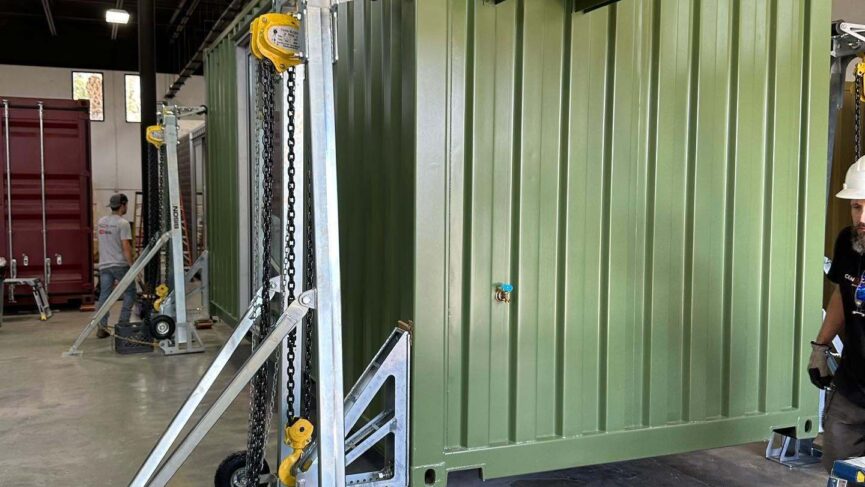
    For operations that only lift containers occasionally or need a simpler system without a power supply, the Bison M Series provides a fully mechanical alternative.

    All three systems are portable, allowing them to be moved to different areas of a facility as container handling requirements change.