Contact us
LHC Banner

How To Lift Very Heavy Containers and Containerized Equipment

Lifting very heavy containers comes with unique challenges. Explore the options for handling loads up to 141,000 lb (64,000 kg), and discover which lifting solution is right for your operation.

Bison Marketing

20 Oct 5 Minutes

Lifting

A fully loaded standard shipping container can weigh up to 71,650 lb (32,500 kg). Special-purpose containers, such as containerized generators, BESS units, process plants, or tanks of dense liquid, are often even heavier, sometimes reaching 100,000 lb (45,000 kg) and more. While large ports and container yards might be set up to handle containers of that weight, once the container leaves those environments, lifting it on and off trucks becomes a challenge. At that weight, the equipment most sites rely on to lift containers can no longer do the job.

Operators needing to lift these very heavy containers outside of ports and shipping yards generally have three options: hiring a large mobile crane, renting or buying a heavy-duty reach stacker, or investing in a portable container lift purpose-built for heavy loads. This guide compares all three options and explains how Bison's portable container lifts enable operators to lift containers of up to 141,000 lb (64,000 kg) in-house without reliance on third parties.
Why Are Heavy Containers Harder To Lift?

Lifting and handling very heavy containers outside of ports and container yards comes with a unique set of challenges.

  • Availability: For starters, fewer machines can do the job. That means it can be harder to find suitable lifting equipment and to get it on site. In some locations, nothing suitable is available at all.

  • Cost: Partly as a result of limited availability of lifting equipment, costs go up. Equipment that can lift a heavy container generally costs more to buy, hire, and transport. In addition, the lift often requires more detailed planning and more people, all of which adds to the cost.

  • Site requirements: Heavy-duty cranes and reach stackers also need more room to set up and maneuver, and a surface strong enough to carry their own significant weight as well as the container's.

  • Complexity: Lifting heavy loads takes more planning and care. Larger equipment usually means a specialist contractor, a booking made well in advance, and more people to coordinate on the day. In addition, many heavy containers hold high-value, sensitive equipment that has to stay level and be handled with care, adding further complexity to the lift.

  • Risk: The stakes are higher. When a heavy lift goes wrong, the consequences are more severe, both in terms of potential harm and damage as well as cost implications.

What Are The Options For Lifting A Heavy Container?

Large ports and container yards often have heavy-duty reach stackers, gantry cranes and other equipment that can handle these loads. However, outside of those purpose-built environments, the options are limited.

Most operators have three options: hiring a large mobile crane, renting or buying a heavy-duty reach stacker, or investing in a portable container lift purpose-built for heavy loads. All three can do the job, but they differ in terms of their strengths and weaknesses and which lifts they are most suited for.

Reach Stacker LHC

Heavy-Capacity Portable Container Lifts

  • Regular lifts of heavy containers

  • Sites with limited space or challenging ground conditions

  • Remote or temporary sites without access to heavy lifting equipment

  • Sensitive or high-value containerized equipment

  • Operators who value control and flexibility

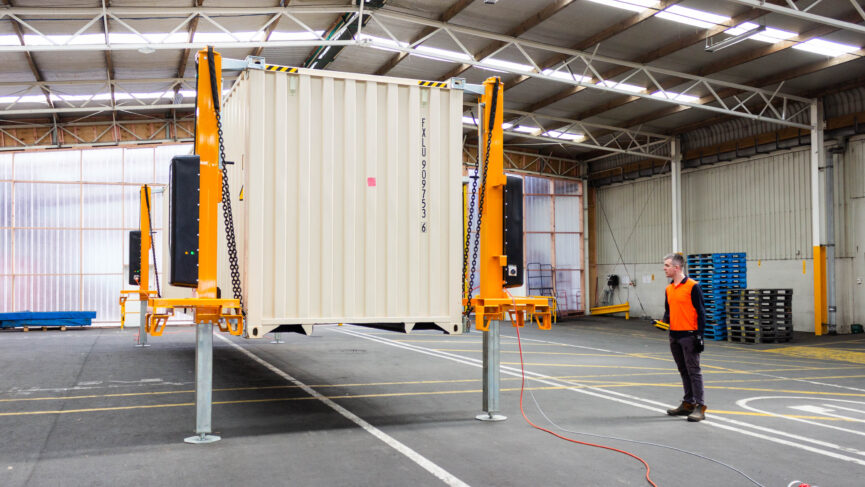
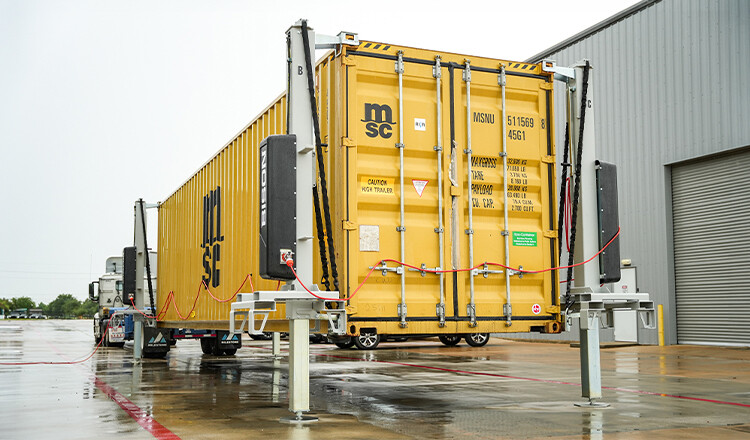
Portable container lifts attach to the container itself and raise it vertically, so the truck can drive out from underneath before the container is lowered to the ground. The same steps are reversed to lift the container back onto the truck. Instead of one large machine, a set of at least four lifting legs or hoists work together to lift the load.

A key advantage of these lifts is size. Portable container lifts are far more compact than cranes and reach stackers, so they suit sites that don't have the room for big equipment to set up and maneuver. That includes tight yards, indoor facilities, and remote worksites.

Being smaller and lighter also helps with ground conditions. Because the lifts weigh far less than a crane or reach stacker, they add much less to the load the ground has to carry. Some portable container lifts are also designed to operate on rough or uneven surfaces.

They're also easier to move. The equipment can be transported on a truck, or even by air, to wherever the container needs to be lifted, which makes remote and temporary sites much easier to reach.

HPA Block


Importantly, portable container lifts are significantly less expensive than heavy-duty cranes and reach stackers. As a result, they are typically owned in-house, giving operators control and flexibility over their lifts. There's no waiting for contractors, no booking well in advance, and no paying for a call-out every time a container needs to move.

High-quality, well-designed portable container lifts are also generally easy to use, and automated models allow one person to complete the lift in 10-20 minutes.

The way they lift also suits sensitive, high-value equipment. A portable container lift attaches at multiple points around the container and raises it straight up in a controlled, stable motion. Self-leveling systems keep the container level and every leg synchronized throughout the lift, so the equipment inside stays stable.

However, there are trade-offs. A portable container lift raises a container vertically for a truck to drive under, so it can't lift a container over an obstacle or up onto a structure, and they can't be used to stack containers on top of each other. It also comes with an upfront cost, although most operators who lift heavy containers usually see a return on that investment quickly.

It's also important to know that not all portable container lifts are built for heavy loads. Many are designed for standard container weights, so lifting heavy containers requires purpose-built, high-capacity equipment. Check carefully that the equipment you're considering is rated to reliably lift the full weight of your container.

Bison C Lift X Series 5

Heavy-Lift Mobile Cranes

When are cranes best for lifting very heavy containers:

  • Occasional lifts at suitable sites

  • Near main centers where large cranes are available

  • Lifts that need height or reach

  • Extremely heavy lifts that other equipment can't handle

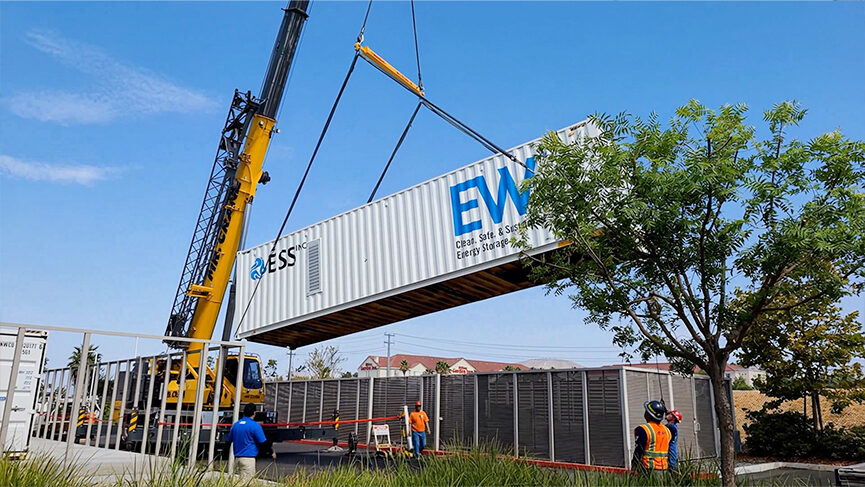
A mobile crane lifts the container from above, using a spreader or vertical slings attached to its top corners, and swings it on or off the truck. Cranes are a very common option for lifting containers, and with a large enough crane, there is almost no container it cannot lift. In addition, it can do something the other options cannot: lift a container over a wall, into a pit, or up onto a structure.

However, there are some challenges and limitations. For starters, cranes that can lift these heavy loads are less widely available, particularly away from major centers. Getting one to the site where the heavy container needs to be lifted can quickly get expensive and might not even be possible at all in some cases. And even if you can get a suitable crane to the site at an acceptable cost, the site itself may not be suitable. These large cranes need room for their outriggers, firm ground, and clear space overhead. If your site can't tick those boxes, using a crane for your lift will be very difficult.

Cranes are also usually hired rather than owned, meaning the lift needs to be planned and booked well in advance and you're reliant on third-party contractors, limiting your control and flexibility.

Finally, when the container load is sensitive or the container itself is a highly valuable piece of equipment, it's often important to keep the container level during this lift, which can be tricky with a crane where the load tends to swing and might tilt towards its heavier end if the weight inside is off-center.

Mobile Crane LHC

High-Capacity Reach Stackers

When are reach stackers best for lifting very heavy containers:

  • High-volume container handling

  • Sites already built for heavy machinery, such as ports, rail terminals, and container yards

  • Containers up to around 99,000 lb (45,000 kg)

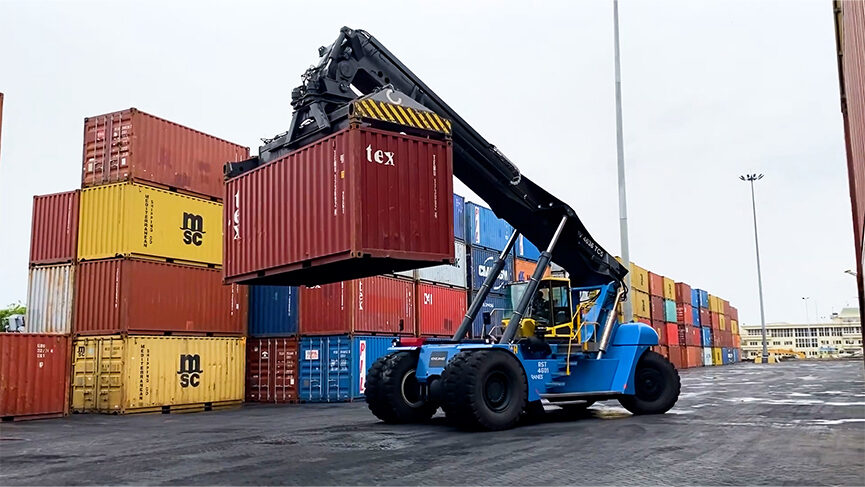
A reach stacker is a large wheeled machine with a telescopic boom and a spreader that locks onto the container's top corners. Reach stackers are the workhorses of ports and container yards. They're fast, built for repetitive work, and heavy-duty models can lift around 99,000 lb (45,000 kg). However, that 99,000 lb (45,000 kg) capacity only applies when the container is close to the machine. As the boom extends, the lifting capacity drops quickly, and containers heavier than that are beyond what even a heavy-duty reach stacker can handle.

Furthermore, outside of ports and container yards, reach stackers come with some significant limitations. For starters, they are big, heavy machines. They need a lot of room to maneuver, and most sites need to strengthen the ground before one can operate safely. If your site wasn't built with heavy machinery in mind, that can mean significant site works before the first lift.

Then there's the cost. A heavy-duty reach stacker costs several hundreds of thousands of dollars, making it a tricky business case for anyone who doesn't lift dozens of containers a day. They can be rented, but that still comes with a significant price tag, and it means getting a very large machine delivered to your site. That takes planning, and it isn't always practical, particularly for remote locations.

Reach Stacker 2
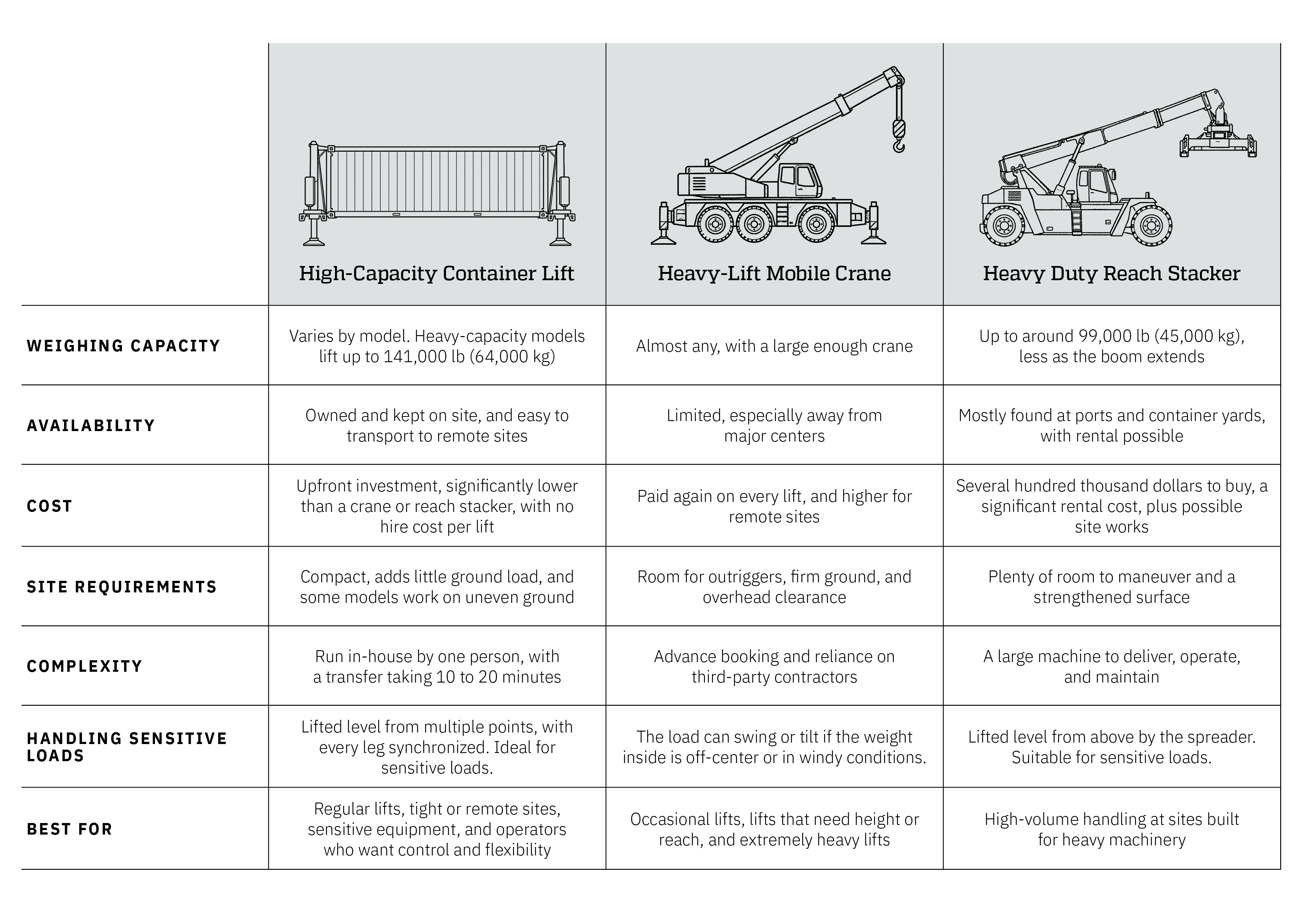
Comparison of heavy container lifting equipment

How Do You Choose The Right Option?

There's no single right answer for every heavy lift. The best option depends on your situation. Ask yourself these five questions:

  • How often do you lift heavy containers? For a one-off or occasional lift, hiring a crane is often the most practical choice. If heavy lifts are a regular part of your operation, the cost and coordination of hiring add up quickly, and owning a portable container lift usually pays for itself.

  • Where do you need to lift? Ports, rail terminals, and container yards built for heavy machinery suit reach stackers. If your site is tight, indoors, remote, or has soft or uneven ground, a portable container lift is usually the better fit. If the container needs to go over a wall or up onto a structure, you'll need a crane.

  • How heavy is the container? Heavy-duty reach stackers top out at around 99,000 lb (45,000 kg). Above that, your options are a large crane or a multi-hoist portable container lift that supports the load at more than four points.

  • What's inside it? If the container holds sensitive or high-value equipment, choose a method that keeps it level and fully supported throughout the lift.

  • How much control do you want? Hiring means working around someone else's schedule. Owning your own equipment means you lift when it suits you.

Heavy Container Lifting FAQs

  • What Equipment Can Lift A Container Over 100,000 lb?

    A heavy-lift mobile crane or a multi-hoist portable container lift such as the Bison A Series Multi-Hoist. Heavy-duty reach stackers top out at around 99,000 lb (45,000 kg). Bison's C-Lift A Series with the multi-hoist option lifts up to 141,000 lb (64,000 kg) by supporting the load at six or eight points.

  • Can You Lift A Heavy Container Without A Crane?

    Yes. A heavy-duty reach stacker can lift containers up to around 99,000 lb (45,000 kg), but is mostly found at ports and container yards. A heavy-capacity portable container lift such as the Bison X Series or the A Series, raises the container vertically off the truck and lowers it to the ground, and can be used almost anywhere. Bison's A Series Multi-Hoist can lift up to 141,000 lb (64,000 kg).

  • Can Any Portable Container Lift Handle A Heavy Container?

    No. Many portable container lifts are designed for standard container weights. Lifting heavy containers needs purpose-built, high-capacity equipment such as the Bison X Series or the Bison A Series. Always check that the lift is rated for the full weight of your container before you buy.

  • How Do You Lift A Container Holding Sensitive Equipment?

    Keep it level and supported throughout the lift. Confirm the weight and where it sits inside the container, and choose a method that lifts it in a controlled way. A crane load can swing or tilt if the weight is off-center, while a portable container lift with a self-leveling system, such as those developed by Bison, raises the container from multiple points and keeps every leg synchronized.

  • How Long Does It Take To Lift A Heavy Container Off A Truck?

    With a heavy-capacity portable container lift such as the Bison A Series or the X Series, one person can complete a transfer in about 10 to 20 minutes. A crane lift usually takes 30 to 60 minutes once the crane is on site, but booking it and waiting for it to arrive can add hours or days.

  • How Much Does It Cost To Lift A Heavy Container?

    It depends on the method. A crane call-out typically costs $5,000 and more for heavy containers or remote sites, and you pay it every time. A heavy duty reach stacker costs several hundred thousand dollars to buy. A portable container lift is an upfront investment, significantly lower than either, with no hire cost per lift.