Contact us
DOWNLOAD THE FREE GUIDE

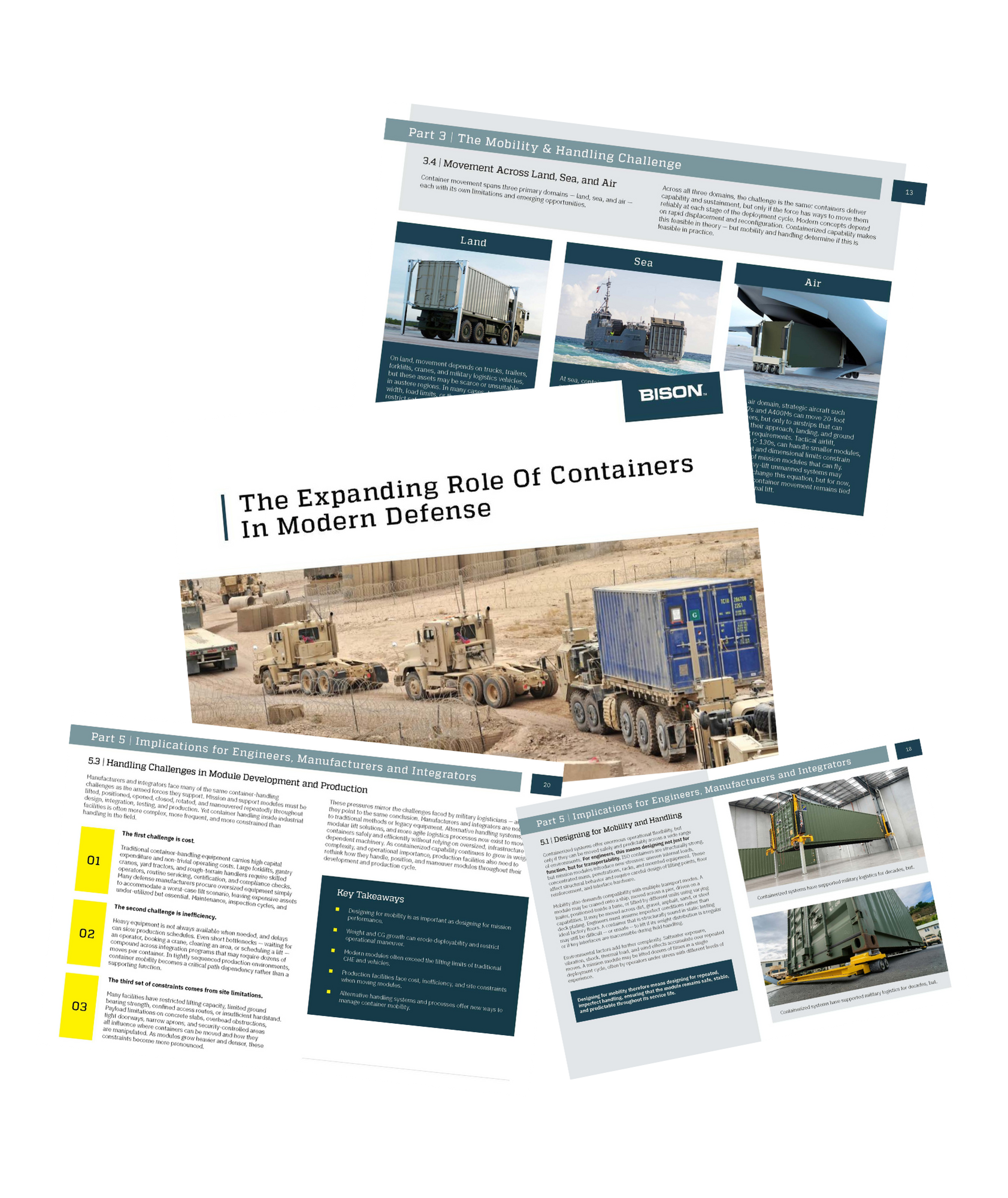
eBook: The Expanding Role of Containers in Modern Defense

A focused guide that explains the expanding role of containers in defense and highlights the key challenges, considerations, and operational factors shaping how they are deployed across military settings.

Why You Need to Read This eBook

Container handling now plays a decisive role in the speed, cost, and readiness of defense manufacturing and military operations. As systems become heavier and mobility requirements increase, teams need smarter, more adaptable ways to lift, move, and verify containers — without relying on heavy equipment or external support.

What You Will Learn

  • Why heavy equipment alone can no longer meet modern defense requirements.
  • The growing role of containers in distributed, expeditionary, and modular operations.
  • Common handling bottlenecks in manufacturing, bases, and field environments.
  • How portable, self-sufficient handling systems improve independence and reduce delays.
  • Industry and military trends driving the need for deployable, infrastructure-light capability.
Contact us

Download Your Free eBook

Learn the factors that shape mobility, efficiency, and operational readiness and discover how modern defense teams manage container handling challenges.

FAQ

  • Why is heavy equipment often unsuitable for modern military container handling?

    Heavy lifting assets like RTCHs, forklifts, and PLS/LVSR trucks are powerful but not always practical in modern operations. Their size, weight, and operator requirements limit use in tight, soft-soil, or infrastructure-poor environments. They’re also difficult to deploy forward — and many modern containerized systems now exceed their lifting capacity entirely.

  • How do expeditionary teams move and handle containers without infrastructure?

    Expeditionary units rely on portable, self-sufficient handling tools that deploy with the team. With no cranes, roads, or fixed infrastructure, containers often arrive by air, sea, or convoy and must be lifted, positioned, or recovered using lightweight, field-ready systems. Portable jacks, dollies, and modular lift kits give teams the ability to move containers anywhere.

  • What are the advantages of portable container handling systems for defense operations?

    Portable handling systems like Bison's C-Lifts give defense teams flexibility, speed, and independence. They can be operated by small crews, deploy rapidly, and work in places where cranes, forklifts, or PLS trucks can’t reach. This boosts responsiveness, reduces reliance on external support, and keeps container movements fully under the unit’s control.

  • How do modern portable handling systems compare to cranes or PLS trucks?

    Portable handling systems don’t replace cranes or PLS vehicles, but they fill critical gaps. Heavy equipment is powerful but needs space, trained operators, and strict scheduling. Portable systems work in tight areas, indoors, or forward locations where heavy machinery can’t operate. They set up quickly, are easier to use, and let teams handle containers on their own schedule without relying on shared assets or contractors.

  • How do teams safely handle sensitive or high-value containerized mission systems?

    Teams rely on handling equipment that delivers precise, controlled movement with minimal manual intervention. Portable lifting and mobility systems keep loads stable, reduce handling risk, and allow sensitive containers to be positioned safely in tight or high-risk environments—without depending on large machinery or complex set-ups.

  • Can Bison support custom engineering for containerized defense platforms?

    Yes. Bison works with defense manufacturers and system integrators to engineer safe, practical deployability into containerized systems. This includes designing lifting interfaces, validating structural lift points, and ensuring platforms can be lifted, weighed, and deployed safely from factory to field. Bison helps teams meet real-world handling requirements early—avoiding costly redesigns later in the program.